Travel Quotes

Mark Twain said, “Travel is fatal to prejudice, bigotry, and narrow-mindedness, and many of our people need it sorely on these accounts. Broad, wholesome, charitable views of men and things cannot be acquired by vegetating in one little corner of the earth all one's lifetime.”

“Perhaps travel cannot prevent bigotry, but by demonstrating that all peoples cry, laugh, eat, worry and die, it can introduce the idea that if we try and understand each other, we may even become friends.” Maya Angelou

_____________________________________________________________________________________
....................."One day your life will flash before your eyes. Make sure it is worth watching." Unknown..................


I would like to welcome new readers to my travel blog. If you are reading this for the first time, then I suggest you first read my introduction which I wrote last November when I started this. It explains why I am writing this and it gives you a little about my background. And most importantly it explains about my list and how it works. To go to that post, click on the following link - http://havelistwilltravel.blogspot.com/2011/11/have-list-will-travel-introduction.html


Wednesday, June 18, 2014

Portugal, Belgium and the Netherlands
 
We just returned from a trip. As in the past, we sent a report home to friends and family, as we traveled.  My husband, George, writes these reports, and put in the pictures.  I always post those reports on the blog - on the side column, under Trip Reports.  If you would like to read about our latest adventures you can go to the Trip Report column and click on the Portugal trip.  We had a good time, but we always are glad to get back home to our 2 dogs.
 
You could also click on this link to go to the report - http://havelistwilltravel.blogspot.com/p/the-old-legend-of-barcelos-cock-once-at.html

Sunday, November 17, 2013

2 Year Anniversary of this Blog


“See the world. It's more fantastic than any dream made or paid for in factories. Ask for no guarantees, ask for no security.”
Ray Bradbury


I have been writing this for two years.  My first posting was on this day in 2011.  It has been fun for me to do, but I am running out of ideas, and now it is starting to be a chore to come up with new things to write.  So I am going to take a break from it.  I may come back and write again, if I think of new things to write about.  When we travel, and we will, I may post reports of those trips.  We are taking a short vacation to Hawaii soon, both to Oahu and the Big Island, but I have already written about those places, so probably won't post anything on that trip.  But we are planning a trip to Portugal, where we will meet up with our friends from Scotland.  I am already planning the trip, and I plan to actually fly into Amsterdam and spend a few days and then take the train to Bruges, Belgium and spend a day there, and then go on to Lisbon to meet our friends.  That is a trip we will certainly report on when we return.  Until then..................

Tuesday, October 29, 2013

What To Do When Things Go Wrong


 "You’re either part of the solution or you’re part of the problem."
 Eldridge Cleaver


Imagine you are on a vacation, one you have paid a lot of money for, and have spent many months anticipating.  It is a tour you booked through a company.  But things are not quite the way you pictured them.  Things are not going smoothly, for what ever reason.  Do you continue along with the tour and complain when you get home, or do you take action to change things while you are on the trip.  And if you decide on the last, how do you go about doing that.

We recently took a trip to Africa.  The trip was very expensive, probably the most expensive trip we have ever taken.  And yes it was through a tour company.  Going to Africa is possible on your own, but certainly easier with a tour company, which will set everything up for you.  We thought the trip was excellent.  Sure, there were a few little snafu's, but after all it is Africa, so some allowances should be made.  But there were several in our group who were not happy.  We didn't even realize they weren't happy, because the way things were set up, we didn't always have interaction with other members of the group.  We were separated into 3 different land rovers for our daily safari's, and we tended to stick with the same group even in the evenings, to a certain extent.  So we were surprised when we found out that some of the group did not feel they were getting the right service.

At the Tanzania Border
We had vendors and others who approached us 
Everything was fine with the whole group until we crossed the border into Tanzania.  We had to wait at the border to pick up new drivers and tour guides, because the law says that the drivers from Kenya cannot continue on into Tanzania.  In a perfect world the new drivers would have been there waiting for us, since they knew we were arriving.  However, we did have to wait for over an hour.  We found out that the Tanzania drivers had a flat tire, and they got delayed partly because of that.  But our Kenyan drivers stayed with us until they arrived, and yes, it was hot, and yes there were people there who were asking for handouts and to sell us things.  I did not have a problem with that, having seen the roads throughout Africa I could certainly understand how there could be delays, and I was enjoying interacting with the people, and even bought a few things.  But that was a major complaint of some of the group.

Some also complained that the luxury tents we had along the way were not as luxurious as they thought they would be.  I personally found them to be quite comfortable, and felt they were part of the experience. 

One person in our group was traveling with her 2 teenage daughters and she was the first one who complained to the company.  She actually called the company that she booked with and had her driver fired on the spot.  She later said that she did not feel safe with him, which surprised all of us. But having got to know her a little bit, I tend to think she over-reacts.  She may not have in this situation, but I know she over-reacted to some other things with the group, which led most of us to believe she was over-reacting again.  Whether she was right to do what she did or not, who knows, but she did take action.  Would you have done the same?

Our group with our driver Juma
After this incident there was more talk between the group about how we felt.  The 4 other people my husband and I were with were happy with our driver and with the service we were receiving.  We had no problems.  We did find out that there were others in the group who had some complaints. They had decided to wait till they got home to put in their comments, but since action had already been taken, the company was immediately wanting our feedback.  They wanted to know if we were unhappy with our drivers and did we want them replaced also.  We loved our driver, Juma, and were concerned he would lose his job because the other driver was fired, and there were some complaints about the third driver.  Everyone in our land rover expressed our happiness with our driver. 

After we returned home the company contacted me and wanted to know everything that had happened and how I felt about the trip.  They were accessing whether to keep the company they had hired in Tanzania or to get a new company.  They were interested in everything that had happened and our feelings.  They sent me a voucher good for a discount on our next trip with them, even though I was basically happy with the service we received.  I'm not sure if they sent the unhappy people a larger voucher, it is certainly possible.

So, if this happens to you, would you call immediately, or wait until you got home.  I guess it would depend on how unhappy you were, and if calling then would change anything.  In her case, she was happier with a new driver.  If you were unhappy about something that had already happened and it couldn't be changed, then complaining when you got home might at least give you a partial refund or a voucher for future travel. 

Our Tent in the Serenget
Some didn't think these qualified as luxury tents

If you do need to put in a complaint, then how do you go about it.  In her case, she used her cell phone and called.  I know my cell phone would not have worked in Africa, but I could have emailed the company and probably have gotten a quick response.  If you are complaining after you get home, then there are several ways to go about it.  If you booked through a travel agent then I would go and tell the agent what happened.  The agent will have a company representative with that company and going directly to the rep will have more pull then on your own.  As a travel agent I handled complaints such as that for clients, and usually got very positive results.  If you booked on your own then the best thing is to put it in writing and either email or mail the letter to the company.  Even if you call them, they will ask for something in writing, so best to just start that way.

But however you handle it, if you are unhappy then you should let the company know.  It is your vacation, you paid a lot of money to go, and you should have happy memories when you come home.  If something has spoiled it, then talk to the company.  You may get a refund, or not.  But by telling them the problem, you may stop it from happening in the future, and help someone else.

Tuesday, October 22, 2013

Destination - Lisbon

"We wander for distraction, but we travel for fulfillment."
 Hilaire Belloc 

"Without new experiences, something inside of us sleeps. The sleeper must awaken.”
Frank Herbert
 
File:Lissabon Strassenbahn.jpg
Tram in Lisbon
As Portugal's capital city, Lisbon holds a concentration of historical and cultural attractions and is the nation's most cosmopolitan city.  Lisbon is a charming mix of now and then.  Old wooden trolleys travel up and down the hills, there are cobbled streets and bird-stained statues, and Art Nouveau cafes to relax and have a cup of coffee.  There are parks, and squares, and old world architecture. Lisbon is one of the few European capitals with both a river and a coastline, the city spreads along the north bank of the River Tagus and meets the ocean.

7 Hills 7 Amazing Views
Lisbon
We have plans to go to Lisbon in 2014.  I have never been there before, although we were close to the border when we were in Spain in 2001.  We will not be on a tour, so I am starting to look into where in Portugal we plan to go, and what there is to see.  I'm sure our first stop will be in Lisbon, so that is where I am starting.  We plan to explore other areas of Portugal, including the Algarve area, which is where we will most certainly spend at least a week.  But Lisbon will be our starting point.

So what is there to see and do in Lisbon?  Like most European cities, just walking around the historic area of the city will be a joy.  The cities in Europe are so different from our cities, with so much history and culture to see.  And for those of us into photography, it is a joy to point our cameras at all the old architecture.  Lisbon will certainly have lots of things for us to see.

My first purchase in Lisbon will most likely be a Lisboa card, which is a Lisbon City Pass and is a great way for tourists, like myself, to save money when seeing the local attractions.  The Lisboa CardOnce purchased, the card offers free or discounted entrance to more than 80 Lisbon museums, sights, and tours, including the Jeronimos Monastery, the Belem Tower and the National Pantheon.  It also gives you free transportation around the city, because the Lisboa Card includes all trips on the Metro, public buses, trams and the Elevadores.  It even covers some sights outside the city, to some of the nearby cities.  The card costs approximately 18 Euros for adults, and 11 Euros for children.

Lisbon is made up of 7 hills, and at the top of each hill an amazing view awaits.  While the hills can be steep for climbing, there are many funiculars and trams connecting them.  the Lisboa Card will come in handy in getting you around the city.

There are three main districts that you should definitely visit while in Lisbon.  They are the Alfama,  Bairro Alto and Belem.  I will probably start my sightseeing in the Belem area of Lisbon, which is where the Age of Discovery began.  Ships commanded by the likes of Vasco da Gama and Henry the Navigator set their sails here returning with tales of adventure, bloodshed, and riches. Discovering a sea route to India, Gama helped aide in Portugal's rise to one of the world's greatest empires. Belem is where two of the most popular tourists sights are - The Belem Tower and the Mosteiro dos Jeronimos.

MargaretCafe PasteisDeNata.JPG
Pastel del Belem- a custard pastry famous in Lisbon
Belem is also where you can purchase a Portugese taste treat known as Pastel del Belem.  These are cream tarts that are famous throughout Portugal, but were first created in 1837 in Lisbon.  The best place to buy these are where they originated in a shop called Casa Pasties de Belem.  Enjoy one with a sprinkling of cinnamon and powdered sugar, with a cup of coffee, or whatever you enjoy to drink.  It is a good way to start off your sightseeing day in the Belem area of  Lisbon.

Torre Belém April 2009-4a.jpg
Belem Tower
Belem Tower is probably the most famous of the local sights.  In Portuguse, it is Torre de Belem or the Tower of St. Vincent.  It is a fortified tower located in the mouth of the Tagus River and is the gateway to Lisbon.  The Tower has been named a UNESCO World Heritage Site,  The tower was  commissioned by King John II and was built in 1515 to guard the harbor of Lisbon.

The tower is open 10AM - 5PM (Oct.- Apr) and 10AM - 6:30PM (May - Sept.).  It is closed on Mondays.  It cost 5 Euros to enter, or with the Lisboa Card it is free.


The Monastery
The Mosteiro dos Jeronimos  (Monastery of Jeronimos) is just a short walk away from the tower.  Its intricate decorations and peaceful spaces will leave you inspired.  It was built in the 16th century and is considered one of Lisbon's most magnificent buildings. Here you will go inside the church to view the architecture, and visit the tombs.  You can also visit the cloisters and there is a garden to walk through.  The monastery is also a UNESCO World Heritage Site.

Inside the Museu da Marinha
Museu Da Marinha (Maritime Museum) is near both the tower and the monastery.  This is the place to go if you want to understand how Portugal rose to become one of the greatest maritime and trading powers in the world.  The museum houses maps, documents, navigational instruments and models of ships from the era of discoveries through to this century.

Palacio da Ajuda is also in Belem.  Just above the pink National Palace (the official residence of the President of Portugal which is not open to the public), is the former Ajuda royal palace, built between 1796 and 1826.  It was occupied by the royal family and remained the royal residence until the abolition of the monarchy in 1910.  It is sumptuously furnished with tapestries, sculptures, oriental carpets and historic paintings.  There is a display of the royal jewelry, crystal and other treasures.  It is still used for state occasions. 


File:Alfama-CCBY.jpg
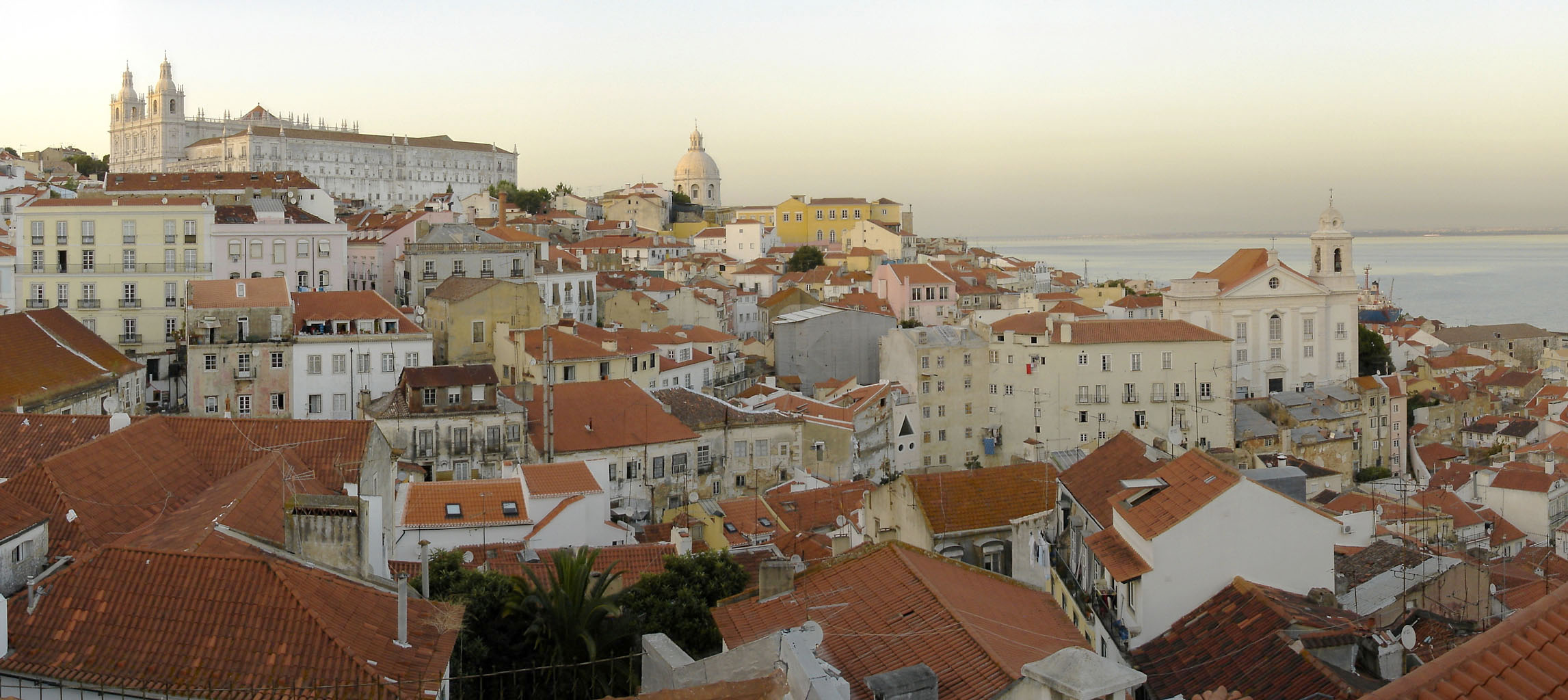
View of Alfama district
taken from the Miradouro de Santa Catarina
The Alfama district is the most famous part of town, which is a labyrinth of alleys, miniature squares and whitewashed houses rising in tiers from the Tagus River.  This is quite a contrast with the area below Alfama.  The low-lying district closer to the river is the Baixa district which was totally destroyed by an earthquake in 1765 and was rebuilt with a precise grid form with magnificent squares and alleys.  But the Alfama district, with its winding cobbled streets and alleys, is best explored on foot during the mid-morning market time or in the early evening with the streets teem with locals.   Exploring the streets and alleyways is a good way to get a feel for Lisbon's Moorish past. A climb through the Alfama district to the castle on top is rewarded by stupendous views over the Tagus and its suspension bridge.

Tower of Ulysses, Lisbon
Tower of Ulysses in Castle Sao Jorge
The Castle of SĂŁo Jorge is a Moorish castle occupying a commanding hilltop overlooking the historic area of Lisbon.  Saint George's Castle can be seen from almost everywhere in the city. Its oldest parts date from the 6th century.  It is now an oasis of peace, but just past the main gate is a statue of King Afonso Henriques and a series of cannons, reminders of the castle's original purpose. What remains of the Alcaçovas Palace where medieval kings lived, is a stone building now housing a restaurant, and round the back, a small archaeological museum in three underground chambers (including the one where Vasco da Gama was once received by King Manuel).

Most of the castle was destroyed over the years, especially in the Great Earthquake, but still includes a long extension of walls and 18 towers. Visitors can climb the towers and walk along the ramparts for the best views of the city, or relax in the gardens where peacocks, geese and ducks strut around. One of the castle's inner towers, the Tower of Ulysses, holds the Câmara Escura, a periscope that projects sights from around the city.  


File:Bairro Alto Lisboa 2.JPG
Bairro Alto
The Bairro Alto district also attracts visitors.  This is the bohemian quarter of the city, rising to the west in steep streets and stone staircases and lined with restaurants and bars.  This is a good place to head for an evening meal.  The area can seem sketchy, but it's as safe as the rest of the city.  The area is a favorite among locals.  The lower part of this district is the elegant Chiado with fashionable department stores and tea houses.  You can catch a lift from there up the hill.


Miradouro de Santa Catarina

The Miradouro de Santa Catarina is a place you should visit for more great views of the city  Next door to the Bairro Alto is the neighborhood of Santa Catarina.  This area has streets of pastel-painted houses but very few restaruants and bars.  It is mostly known for its garden with a terrace offering river views. Within this terrace you will find a stone figure of Adamastor, a mythical sea monster from the poem "The Lusiads."  There is also a pleasant cafĂ© where locals go to admire the dawn view over the Tagus.  You will also have a great view of the 25th of April Bridge over the Tagus,  which is one of the longest suspension bridges in the world.

If you would like to take a tour of the city or a day tour to some areas near Lisbon there are lots of companies available.  But the one that I would book if I was doing a tour is with a company called "We Hate Tourism Tours".  They seem to do more individual type tours, and not the usual things that anyone can see.  From the reviews I read online from people who had taken the tour, it was more like being shown the area by a good friend who lived there.  Not the typical big bus experience for sure.


File:Alfama (by Awersowy) 6.jpg
When you wander the back streets of a city
you see how people live and get a feel for
the city.
There are certainly many more things and areas to see around Lisbon.  Like anyplace you visit you need to just get a feel for the place, and to do that you should wander around by foot, as much as possible, and sample the food, do some people-watching and just soak up the sights and sounds of the city.  You should visit the local flea markets or open markets when you see them.  There is even a Thieves Market, which is in the area of Igreja de Sao Vincente de Fora.  Here you can browse through all sorts of interesting things to purchase.  There are also some pretty good antique shops and stalls that you will find while exploring.  Just walking around exploring a new city is my favorite part of traveling.


**pictures taken from the internet


Wednesday, October 16, 2013

Destination - Bruges, Belgium


"If you set out to design a fairy-tale medieval town it would be hard to improve on central Bruges. Picturesque cobbled lanes and dreamy canals link exceptionally photogenic market squares lined with soaring towers, historic churches and old whitewashed almshouses."


Bruges, Belgium
 
Bruges is a charming city of medieval architecture and cobbled streets.  Since 2000, the Historic Center of Bruges has been a UNESCO World Heritage Site, for its "outstanding example of a medieval historic settlement, which has maintained its historic fabric as this has evolved over the centuries."  Canals, cobblestone paths, and medieval and gothic buildings give the city an old world feel.

I have not yet been to Bruges, although it is one of the stops we plan to make in 2014 when we meet up with our friends from Scotland.  My plan is to fly to Amsterdam, then take the train to Bruges, and then on to Lisbon, where we will meet them.  We'll have 6 days on our own and then 2 weeks with them in Portugal, which should gives us some time to explore.  So now I am looking at what there is to do in those cities.

The area of Bruges that most tourists spend all their time in, is the Historic Center of Bruges which is contained within a canal, or moat.  Nearly everything of interest and importance is within this convenient cobbled stone area between the train station and Market Square.

Market Square and the Bell Tower
Market Square (Markt) - This is the heart of the city. It is ringed by banks, the post office, restaurants and dominated by the 290 foot high bell tower.  Most of the buildings are gabled and quite majestic. Horse-drawn carriages clip-clop through the square.  Geldmuntstraat, just off the square, is a delightful street with many fun shops and eateries. 

Bell Tower (Belfort) - This bell tower has presided over the square since 1300.  It is 366 steps to the top, and the view is worth the climb and the small charge.  It is open daily from 9:30 a.m. to 5 p.m.  Just before you reach the top you should peek into the room with the 47 bells which are played on the quarter hour. 

 
File:Bruges De Burg.JPG
Burg Square
Burg Square - This is Bruges civic center, historically the birthplace of Bruges and the site of the 9th century castle of the first Count of Flanders.  Today it is the scene of outdoor concerts and a place for people to gather.  It is surrounded by six-centuries of architecture.

Flemish art and the Gruuthuse Museum which is a 15th century mansion of a wealthy merchant and displays period furniture, tapestries, coins and musical instruments. Those are probably the most well known of the museums in the city.  There is also a lace museum - The Face of Lace.  Belgium is famous for its lace.

Madonna & Child
There are churches with wonderful architecture to see.  The two most frequented by tourists would be the Basilica of the Holy Blood (which supposedly has some of Christ's blood), and Church of Our Lady which stands as a memorial to the power and wealth of Bruges in its heyday.  It has on display a sculpture by Michelangelo - Madonna and child.  This exquisite sculpture was the master's only work to leave Italy in his lifetime.  One oddity, high up in the church wall, is the personal observation room of the Gruuthuse family who lived in the adjoining palace, now the Gruuthuse museum.

You could also visit the City Hall's Gothic Room which is full of maps and paintings,  The Gothic Hall which dates back to the 1400's features painted and carved wooden ceilings and hanging arches.  And the Renaissance Hall has a chimney carved from oak.  If you are into heraldry this is a good place to stop and look around.


Picture of Belgian Chocolate Shop The Chocolate Line in Bruges
Chocolate Line Shop
But there is so much more too Bruges then just the history and the architecture.  For foodies you have to stop and try the  famous Belgium chocolates.  Some of the best places to buy chocolate are Dumon and The Chocolate Line.  In fact, there is a chocolate museum, The Choco-Story where you learn all about chocolate.  Don't forget that fries (or chips) were invented in Belgium, not France, and you will find stalls that sell these, and there is even a museum to visit about them, the Frietmuseum.  Bruges is also famous for their beer.  The local brewery, De Halve Maan, is open for daily tours, you will get one free sample of beer and there is a good cafĂ© where you can get a good meal with of course, a beer.


boats on the canal
There are lots of tours available.  There are boat tours of Bruges' canals which are a great way to take in the medieval architecture of the city.  And a tour that I thought looked interesting was the Quasimodo Tours which specializes in full (and half) day tours of the historic castles, chateaus and landmarks of Flanders.  It even takes you to visit the WWI landmarks of Flanders Fields.  This tour would get you out of the city to show you some of the surrounding areas.

Just a 10 minute walk from the historic center of town you can visit the city's northeast area, where you will find authentic, lived in Bruges with its quiet cobbled streets of step-fronted houses in brick.  The houses quite often have hand-made glass windows and doors that are painted burgundy and dark green.  If you walk a little further you can get to the windmills next to the canal at Kruisvest.  You can also visit the Lace Centre, where you can learn all about Belgium's lace, which includes demonstrations.

Street Food in Bruges includes waffles
You'll find some good places to eat in Bruges.  The specialty of the city is mussels, cooked a variety of ways.  You can eat outside in the squares or along the canals.  These places are great for people watching and are popular with tourists.  Some of the better places are the bistros on the back streets where the locals eat.  There are also many bars or pubs where you can get a light meal or a drink.  And when visiting any new place, I love to try the street foods.  In Bruges that would be the fries and the Belgium waffles which are not eaten for breakfast but as a snack.


Belgium Chocolate
Bruges is a city for walking around in, for taking in the sights and the architecture and soaking up the atmosphere.  For enjoying the canals and taking a boat ride.  And certainly for enjoying the chocolate and the beer, both of which I love.  I'm looking forward to exploring this city.


Tuesday, October 8, 2013

Destination - Amsterdam


“Some tourists think Amsterdam is a city of sin, but in truth it is a city of freedom. And in freedom, most people find sin.”
John Green
 
Bloemgracht
Amsterdam
 
I have never been to Amsterdam, but we are planning a trip in May of next year, and Amsterdam will be one of our stops.  The main part of the trip will be visiting our friends from Scotland and traveling with them throughout Portugal.  But I plan to first fly to Amsterdam and spend a few days there before going on and meeting them.  We will probably take the train from Amsterdam down to Lisbon, where we will meet up with them and travel from there.

When I think of Amsterdam I think of canals, and tulips, and maybe wooden shoes.  I also think about the red-light district which it is so famous for, and the fact that you can smoke marijuana there. And of course, I also think about Anne Frank and what happened to her and her family.  I think Amsterdam will be an interesting place to spend a few days.

The hidden room where Anne
and her family lived.
I think our first stop will be the Anne Frank House,  I have been a little bit fascinated with her since my teen years when I read her diary.  She was a brave girl, and that was a terrible time. 

The Anne Frank House is the house where Anne Frank lived when she wrote her famous diary.  She hid from Nazi persecution with her family and four other people in hidden rooms at the rear of the building. As well as the preservation of the hiding place — known in Dutch as the Achterhuis — and an exhibition on the life and times of Anne Frank, the museum acts as an exhibition space to highlight all forms of persecution and discrimination.

The house is open  from April 1 through October 31 daily from 9:00 am - 9:00 pm, (Saturdays from 9:00 am - 10:00 pm).  In July and August the museum is daily open till 10:00 pm.  November 1 through March 31 daily from 9:00 am - 7:00 pm (Saturdays from 9:00 am - 9:00 pm).  Last Admittance is 30 minutes prior to closing.  Unfortunately, the old part of the Anne Frank House, which includes the Secret Annex, is not accessible to wheelchair users because it is in the attic of the house. The new building with the current exhibition, the museum cafĂ© and the museum store is accessible to wheelchair users. You enter this part of the museum, which has an elevator and a specially adjusted restroom, through a special entrance. The employees of the museum will help you.


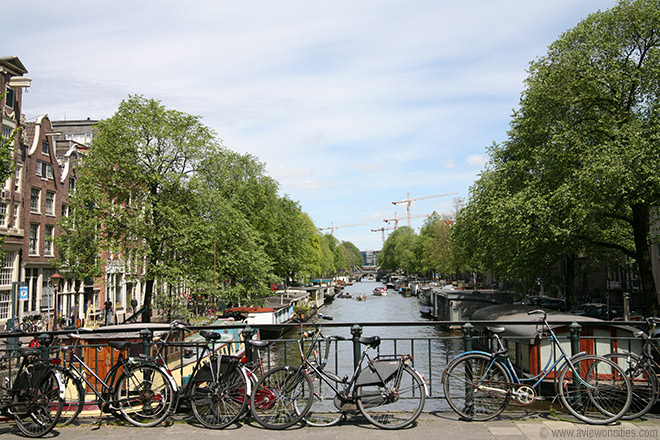
Prinsengracht
Amsterdam - Prinsengracht Canal
After visiting the Anne Frank House we will certainly explore the canals.  There are 165 canals that encircle the city and keep the sea at bay.  The canals are criss-crossed with bridges to help you get around.  They are lined with museums, shops, galleries and cafes.  The most picturesque of canals is Prinsengracht, lined by shady trees and funky houseboats. This is where the Anne Frank House is located. A smaller canal areas that is worth visiting is the historic Brouwersgracht, one of the city's most desirable residential addresses.

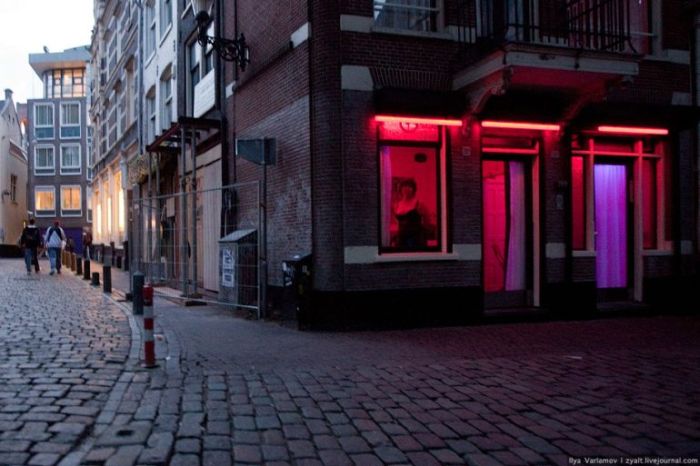
Red Light District in Amsterdam (23 pics)
Picture of the Red Light District of Amsterdam
Taken from the Internet
It isn't advisable to take pictures in this area

And at some point I'm sure we will wander
through the Red Light District which has cultivated such a notorious reputation. Situated in a rough triangle formed by the Central Station, it's the oldest part of the city. But its historical significance has been largely obscured by the popularity of window-shopping in the area. Along its streets, the multi-cultural community of prostitutes, junkies, clerics, carpenters and cops freely intermingle, exhibiting a strange kind of social cosiness. As a tourist, of course, I'll be a mere voyeur.  I am told that you should not take pictures in this area.  There have even been fights over this, and cameras have been destroyed.

As for other things to do, here are a few suggestions:

The Van Gogh Museum is an art museum dedicated to the works of Vincent van Gogh and his contemporaries.  The museum's collection is the largest collection of Van Gogh's paintings and drawings in the world.  Here are their hours of operation:
  • 1 May 10 am - 6 pm./2 May to 1 September - daily 9 am - 6 pm,  Friday until 10 pm.
  • 2 September to 26 December - daily 9 am until to 5 pm, Friday until 10 pm.
  • 27 December to 5 January - daily 9 am until to 6 pm, Friday until 10 pm. 
  • From 6 January to 1 May -daily 9 am until 5 pm, Friday until 10 pm.
Times subject to change at any time.

Stedelijk Museum - This bath tub shaped museum has an amazing collection of 20th and 21st-century artists. It holds pre-war works by CĂ©zanne, Picasso, Matisse and Chagall, plus a selection of paintings and drawings by Malevich. Post-1945 artists include De Kooning, Judd, Lichtenstein, Nauman, Stella and Warhol.

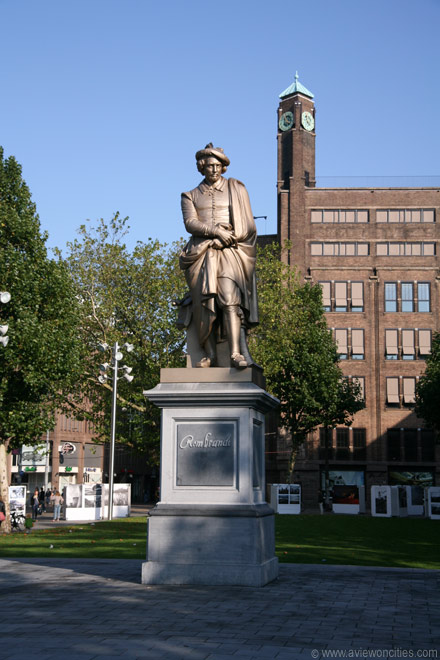
Rembrandt Statue, Rembrandt Square
Statue of Rembrandt
in the square.
Rembrandt Square is one of the most famous squares in the city.  It is a great place to wander through and people-watch, which is one of my favorite things to do when I am traveling.  There are quite often street performers who entertain the square and the cafe terraces where you can relax over a cup of coffee or a meal.  This former butter market is a one-stop entertainment hub, with diverse attractions on the perimeter of the square and in its immediate vicinity.  One such place is the CafĂ© Bolle Jan which is an Amsterdam institution and the sort of place visitors will find nowhere else – a crowded but convivial bar, its walls steeped in history, where Amsterdammers come to listen to traditional Dutch folk music.  There is a statue of Rembrandt in the Square.

Vondelpark is the perfect spot to have a picnic.  It is the largest green space in Amsterdam.  The park is a cultural hub, with a number of sculptures, including one by Picasso.  From June to September people gather here to meet up and there is quite often music, dance and kids' activities.


Prinsengracht seen from Prinsenstraat
Bicycles are very popular
in Amsterdam
As for other things to do, you can rent a bike and join the locals in riding around the city.  You will also find lots of people skating in the city and there are skates for rent if you care to join them.  At the Begijnhof, you will find a secluded garden and courtyard which offers a hidden sanctuary where traffic sounds dim and the bustle of the city fades into the distance. 

Another thing to do would be to visit the local flea markets to discover the multi-ethnic spirit of Amsterdam. The most famous is the Albert Cuypmarkt, a large general market that snakes through the heart of Pijp. It offers a great insight into Dutch life, selling everything from smoked eel to Surinamese sherbets. Neighbourhoods have their own markets: the Dappermarkt in Oost and the Lindenmarkt in Jordaan are the most authentic. Also in the Jordaan, the Noordermarkt sells organic farmers' produce on Saturdays and hosts an antiques fair on Mondays – which is less touristy than the big, bustling bazaar of the Waterlooplein flea market.

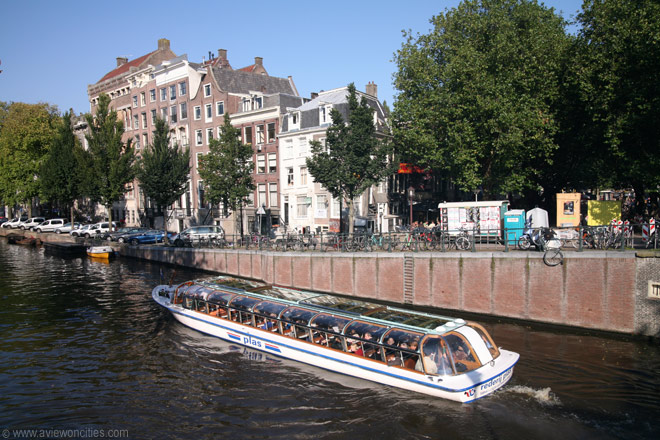
Canal cruise
You can take a canal cruise to see the sights
Of course, there are many tours that can be arranged, the best being walking tours which will give you a chance to orientate yourself to the city.  Take a canal cruise to explore Amsterdam's historic canals by boat. It's the perfect way to enjoy a romantic dinner or simply relax and sightsee. A bike tour is a good way to see the sites of the city. You can also discover the city by scooter or Segway.

Example of work by
The London Police
There are many more museums to visit.  It is a city full of museums and art.  You can also see art without visiting a museum.  Amsterdam has an active street art scene. Every corner of town is a place to discover images of all shapes and sizes, from freehand graffiti to stencils, sculptures and stickers.  Many urban galleries have picked up on the street art scene, including Go Gallery on the stately Prinsengracht, which sells works by The London Police (2 guys who have drawn bubble-headed cartoons all over the walls of Amsterdam) a stone's throw from a giant wall-side example of their monochrome bubble-headed cartoons.

While in Amsterdam make sure you try there food.  One of the best things about travel - in my opinion - is trying the locale food.  It makes you feel more apart of the place.  There are many nice restaurants and cafes along the canals of Amsterdam.  Most cafĂ©s open in the morning and don't shut until 1am or 3am during weekends.  There are many traditional dishes to try.  Amsterdam is also famous for its Indonesian cuisine, which comes from the post-war years when the food was introduced by Indonesian immigrants.  Try the rijsttafel (rice table), an extravaganza of veggie, fish, and meat, served in small but mouth-watering portions.

And don't forget the street food.  I love trying foods in other countries that you can pick up at little places on the streets of the city you are visiting.  These foods really represent the culture of the destination.  In Amsterdam the favorite street foods are:

Poffertjes

  •  Poffertjes are small, fluffy pancakes made with yeast and buckwheat flour. These tasty treats are prepared using a special pan with several shallow indentations in the bottom to hold the batter and make perfectly puffed small pancakes. Poffertjes are typically served topped with powdered sugar and butter.
  • Bitterballen are deep-fried snacks that are ubiquitous in cafes and bars all over the Netherlands. These savory orbs are battered in a crunchy breadcrumb coating and filled with a gooey mixture of chopped beef, beef broth, flour, butter, herbs and spices. They are typically served with mustard for dipping.
  • stroopwafel (syrup waffle)  is a chewy cookie.  It was first made in the town of Gouda in the Netherlands during the 18th century. In fact, until 1870 stroopwafels were made only in Gouda and there were about 100 bakeries selling these treats in that city alone. 
  • Hollandse nieuwe haring should be tried at least once. The raw herring fish is typically served with chopped onions, and can be eaten with or without bread.
Once you have seen the sights of Amsterdam, you might consider hopping on a train and going to one of the oldest theme parks in the world.  It is just a little over an hour away by train and would be something you could do in one day.   This would be a fun destination for you if you have children with you.

The Ride - The Python
at Efteling Theme Park
Efteling is located in the town of Kaatsheuvel, in the municipality of Loon op Zand. This theme park is one of a kind. Once you arrive you will feel as if you have been transported to different world. The park offers a harmonious mix of fairy tales, folk tales and legends, spectacular attractions and rides, excellent restaurants, breathtaking scenery and enchanting venues. 

There is lots to do at Efteling.  There is a water show, a carnavel attraction where you learn about carnavels in 15 different coutnries including their costumes and music, there is a maze you can get lost in, and some high-speed rides such as Joris which is a double wooden roller coaster where 2 coasters (dragons) fight each other - it almost seems as if they will crash into each other but they don't, or the high speed bobsled down an icy mountain.  There is also the Flying Dutchman ride where you are sure to get wet, and you can visit Raveleijn which is a magical city which tells the adventure of five children who become knights.

Keukenhof Gardens
Amsterdam is a few hours away from the charming Dutch countryside. You could take a trip to see the Zaanse Schans windmills, the fishing village of Volendam, the miniature park of Madurodam, Alkmaar cheese market, or the famous Keukenhof Gardens, where there are over 7 million tulips, daffodils and hyacinths to see.  All of these day trips would be possible to arrange through a local tour company, or you could rent a car and see them on your own.

I know I plan to do quite a few of the things above when we visit, and I am looking forward to seeing this city.