Travel Quotes

Mark Twain said, “Travel is fatal to prejudice, bigotry, and narrow-mindedness, and many of our people need it sorely on these accounts. Broad, wholesome, charitable views of men and things cannot be acquired by vegetating in one little corner of the earth all one's lifetime.”

“Perhaps travel cannot prevent bigotry, but by demonstrating that all peoples cry, laugh, eat, worry and die, it can introduce the idea that if we try and understand each other, we may even become friends.” Maya Angelou

_____________________________________________________________________________________
....................."One day your life will flash before your eyes. Make sure it is worth watching." Unknown..................


I would like to welcome new readers to my travel blog. If you are reading this for the first time, then I suggest you first read my introduction which I wrote last November when I started this. It explains why I am writing this and it gives you a little about my background. And most importantly it explains about my list and how it works. To go to that post, click on the following link - http://havelistwilltravel.blogspot.com/2011/11/have-list-will-travel-introduction.html


Showing posts with label volcanoes. Show all posts

Sunday, August 25, 2013

Hawaii Volcanoes National Park

"Volcanoes are monuments to Earth's origin, evidence that its primordial forces are still at work. During a volcanic eruption, we are reminded that our planet is an ever-changing environment whose basic processes are beyond human control. As much as we have altered the face of the Earth to suit our needs, we can only stand in awe before the power of an eruption."
Taken from the National Park page
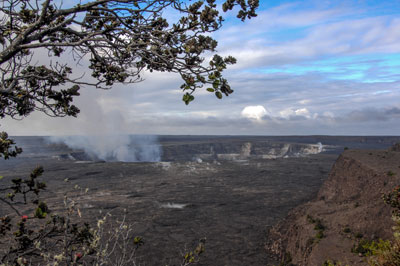

Click for large image
Kilauea Overlook in Volcanoes NP
For almost one hundred years, Hawaii Volcanoes National Park has offered its visitors a window into the past through the many and varied cultural sites contained within its boundaries. Established as Hawaii National Park in 1916, the landscape of Hawaiʻi Volcanoes has been shaped by the people who have been a part of its history. Over five centuries before the establishment of the park, Native Hawaiians lived, worked and worshiped on this sacred ground.

I visited Volcanoes National Park about 5 years ago.  As a travel agent we are sometimes sent on what is known as a FAM trip.  The trip is to familiarize us with what there is to see and do, and places to stay in the area they have sent us.  I was sent on a FAM trip to the big island of Hawaii.  It was a dirty job, but someone had to do it.  It was a week of seeing the sights of the island, spending time touring the different hotels there, and even relaxing and enjoying ourselves, all at company expense.  Not a bad way to go.  One of our days on the island we drove over to the other side of the island and toured Volcanoes National Park.  It was a very informative day, and one I very much enjoyed.  Now, my husband and I along with another couple, are planning a trip to the big island in January, so I decided to take another look at what there is to see and do at the park, which we are sure to visit again.

Steaming Bluff
Steam vents at Steaming Bluff in Volcanoes NP
Hawaii Volcanoes National Park is open 24 hours a day year-round, including all holidays.  The Kilauea Visitor Center is open daily from 7:45 a.m. to 5:00 p.m.  The Jaggar Museum is open daily from 8:30 a.m. to 7:30 p.m.  And the Kahuku Unit is only open on Saturdays and Sundays from 9 a.m. to 3 p.m. Kahuku is closed on the first Saturday of each month, week days and federal holidays.

The Kiluea Visitor Center should be your first stop when entering the park.  The center features informative displays and has the movie "Born of Fire..Born of the Sea", which is shown on the hour throughout the day, starting at 9:00 a.m. and showing the last film at 4:00 p.m. One thing to remember when you go is that the park is located at 4000' elevation and the weather can change very quickly. You should be prepared for hot or cold and sunny or rainy. A warm, sunny day can change to cold and rain in a matter of minutes.  So make sure you take along some warmer clothes to slip into if you need them.
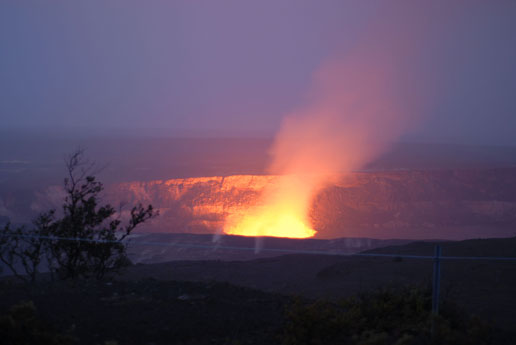
Click for full size image
View from Jaggar Museum Overlook
Another place you should stop is the Jaggar Museum.  This museum is on volcanology with seismographs and other equipment used by scientists to monitor volcanoes. The overlook offers spectacular views into the summit caldera and it is also the best and closest place to observe a volcanic eruption at present.  During the daylight hours the robust plume of volcanic gas is a reminder of the molten rock churning in a lava lake beneath the crater floor.  After sunset, Halema'uma'u continues to thrill visitors with a vivid glow that illuminates the clouds.

The following is a recommendation from the National Park Page on things to do in the park:


Holei Sea Arch at
end of Chain of Craters Rd.
One to 3 Hour Visit?
If you have only one to three hours, explore the summit of Kīlauea volcano via the Crater Rim Drive; an 11-mile road that encircles the summit caldera, passes through desert, lush tropical rain forest, traverses the caldera floor, and provides access to well-marked scenic stops and short walks. (Note: Crater Rim Drive is closed between Jaggar Museum and the Chain of Craters Road junction due to volcanic activity in Halema'uma'u.)

Four to 5 Hour Visit?
If you have four to five hours, you may also explore the East Rift and coastal area of the Park via Chain of Craters Road. This road descends 3,700 feet in 20 miles and ends where lava flowed across the road in 2003.  At the end of the road you will find the ocean and the Holei Sea Arch.

  
Bridge into lava tube
Thurston Lava Tube, Volcanoes NP

One of the stops on the Crater Rim Drive is a stop at the Thurston Lava Tube.  I particularly remember walking through this tube when we visited.  Just before you arrive at the tube the forest becomes increasingly lush. From the parking area it is a 20 minute, 1/3 mile walk through a tree fern forest.  This is an excellent place to stop and listen to the birds. This lava tube was discovered in 1913 by Lorrin Thurston, a local newspaper publisher. At that time the roof of the tube was covered with lava stalactites, but those soon disappeared to souvenir collectors.  As you walk through the tube consider that several hundred years ago a river of red lava rushed through. And that lava currently travels from Pu'u O'o to the ocean in a labyrinth of lava tubes much like the tube you are walking through. Watch your head in the tube - there are some spots with a low ceiling!

There are so many things you can do when visiting the park.  There are hiking trails, including hiking out to where the active lava is flowing, but do so with caution and make sure you have good hiking shoes to protect your feet, and take water to drink.  You can also bicycle the roads of the park.  There are also many ranger led programs.  If you want to spend more than a day in the park then there are campgrounds and lodging in the park, as well as in nearby Hilo.
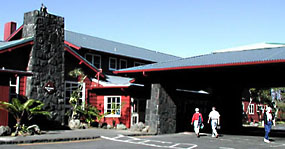
Volcano House is nestled on the rim of Kīlauea and across the street from the Kīlauea Visitor Center
Volcano House provides
Lodging and a restaurant
Lodging - There is lodging available at the Volcano House.  Perched on the rim of Kīlauea caldera with a view toward Halema'uma'u crater, and just a short walk across Crater Rim Drive from park headquarters and the Kilauea Visitor Centrer, the historic Volcano House is known for its Hawaiian hospitality, and its location within Hawai'i Volcanoes National Park.  The restored Volcano House offers 33 historic guest rooms, a dining room, snack bar, lounge, and gift shop, along with cultural events and demonstrations.

Nāmakanipaio Campground
Namakanipaio Campground
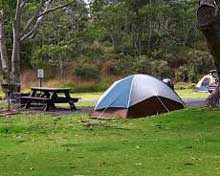
There are two campgrounds in the park, Namakanipaio and Kulanaokuaiki.   Namakanipaio Campground is located at 4,000' elevation.  It is a large open grassy area with tall eucalyptus and ohi'a trees.  The campground has restrooms, water, picnic tables and barbecue pits.  Maximum stay is 7 days.  There is a fee of $15 per night for the drive-in sites and $10 per day for the walk in sites. There are also 10 newly refurbished camper cabins and campsites nearby Nāmakanipaio Campground.  At Kulanaokuaiki camping is free and is available on a first-come basis.  No reservations and no permits are necessary.  Stays are also limited to 7 days in a month.  It is at an elevation of 2700'.  There is no water at this location, and only 8 campsites.  There is a vault-type toilet and picnic tables.  Fires are not permitted.   
 
camper cabins in Namakanipaio Campground
Cabins at the Namakanipaio Campground.
For more information about the park, including fees and hours of operation, and other things to see and do, go to:  http://www.nps.gov/havo/index.htm


Thursday, August 15, 2013

Lassen Volcanic National Park

"It is fine wherever my feet take me
As long as there are sights to see"
Unknown


Lassen Volcanic National Park which is located in northeastern California, is home to smoking fumaroles, meadows of wildflowers, clear mountain lakes, and numerous volcanoes. Jagged peaks tell the story of its eruptive past while hot water continues to mold the land.  All four types of volcanoes found in the entire world are represented in Lassen Volcanic National Park. Volcanoes found in the park include shield (Prospect Peak), plug dome (Lassen Peak), Cinder Cone (Cinder Cone), and Composite (Brokeoff Volcano) volcanoes.

Manzanita Lake with Lassen Peak in the background
Lassen Volcanic National Park started as two separate national monuments designated by President Theodore Roosevelt in 1907: Cinder Cone National Monument and Lassen Peak National Monument.  It became a National Park on August 9. 1916.

The greater Lassen area has been volcanically active for about three million years. Recently the region has seen eruptions from Cinder Cone (~350 years ago) and Lassen Peak (~100 years ago). While the area sleeps now, steam vents, boiling springs, and bubbling mudpots remain active--direct evidence that the volcanic center still smolders. No one can say when or where the next eruption will occur. We can only say that it will.

Inside Lassen Volcanic NP
We visited Lassen NP for the first time on our way home from our annual trip to Washington just a few weeks ago.  It was a short detour off our route home, and since we hadn't visited it before, we decided to take the detour.  It is a smaller park than many of our National Parks, but well worth the stop.  We had our dogs with us, so we were limited to what we could do there, so we just took the road through the park.  Dogs are permitted in the park, but only in the paved areas, they are not permitted on any of the trails.  If you want to hike any of the trails, or participate in any of the ranger programs, then you should definitely plan to spend a couple of days here.

Lassen Volcanic National Park is open all year long, 24 hours a day, but during the winter months road access is limited due to the snow.  Many facilities are open for the summer season only; however the Kohm Yah-mah-nee Visitor Center at the southwest entrance is open year-round. If going in the winter months it is advisable to check road conditions prior to going to the park.

This is the trail that leads to the top of Lassen Peak. 
There are plenty of activities to participate in.   There is of course, hiking, with lots of trails to explore.  Lassen Volcanic National Park offers over 150 miles of hiking trails for visitors of all levels of ability. Discover the devastation of Lassen Peak's last eruption on the accessible trail at the Devastated Area, explore Lassen's largest hydrothermal area on the Bumpass Hell trail, or spend the day climbing Brokeoff Mountain and enjoy its spectacular panoramic views.  There is also boating on the lakes, swimming, fishing, stargazing, bird watching, camping and in the winter you can go snowshoeing, or just play in the snow.

Lassen receives over 30 feet of snow on average each winter! The season often begins in October and persists through June or July.  Snow playing, skiing and snowshoeing are great ways to enjoy Lassen's winter wonderland.  You can join the rangers for a ranger-led snowshoe program offered January through April.

Creek at Sulphur Works
There are many ranger-led programs throughout the year.  There are guided hikes of the Mill Creek Falls trail to learn about our solar system.  There are constellation tours and stargazing.  There are tours that will teach you about black bears or cougars.  There are bird watching programs, and programs that will teach you about volcanos or the mudpots, fumaroles and boiling pools at the Sulphar Works.  There are quite a few programs designed just for kids.  They can become junior rangers or junior firefighters.

Because of the hydrothermal areas it is important to always stay on the established trails and boardwalks. Ground in hydrothermal areas can look solid but may actually be a thin crust hiding pools of acidic boiling water or mud. Traveling off-trail in these areas may result in severe injury. You can view one of these bubbling hot hydrothermal areas at a viewing spot along the road at the Sulphur Works.  It is one of the first stops on the main road shortly after entering at the Southwest entrance.

Camping in Lassen NP
If you want to stay in the park there are cabins at Manzanita Lake that you can rent through the park services.  They are rustic and they are the only cabins in the park, so book early.  There are eight campgrounds in the park.  Approximately half of the park's campsites are reservable.   Four campgrounds are first-come, first-served.  All group sites and stock corrals require reservations. Each campsite has a picnic table, fire ring equipped with grill, and a metal bear box for food storage. There are no hookups in the park. A dump station is located near Manzanita Lake.


For more information about Lassen Volcanic National Park, including fees, pet policy, making reservations for the cabins and camping information, things to do, ranger programs or special events - go to: http://www.nps.gov/lavo/index.htm

View from Bumpass Hell
Lake Helen


Me at Bumpass Hell


Diamond Peak