Travel Quotes

Mark Twain said, “Travel is fatal to prejudice, bigotry, and narrow-mindedness, and many of our people need it sorely on these accounts. Broad, wholesome, charitable views of men and things cannot be acquired by vegetating in one little corner of the earth all one's lifetime.”

“Perhaps travel cannot prevent bigotry, but by demonstrating that all peoples cry, laugh, eat, worry and die, it can introduce the idea that if we try and understand each other, we may even become friends.” Maya Angelou

_____________________________________________________________________________________
....................."One day your life will flash before your eyes. Make sure it is worth watching." Unknown..................


I would like to welcome new readers to my travel blog. If you are reading this for the first time, then I suggest you first read my introduction which I wrote last November when I started this. It explains why I am writing this and it gives you a little about my background. And most importantly it explains about my list and how it works. To go to that post, click on the following link - http://havelistwilltravel.blogspot.com/2011/11/have-list-will-travel-introduction.html


Showing posts with label Spain. Show all posts

Monday, May 20, 2013

Festivals Around the World

"Life is a festival only to the wise."
Ralph Waldo Emerson

 
Rides set up at the festival on the Canary Islands
My last posting was on festivals you can attend here in the United States.  Our cities and towns all put on local festivals to celebrate just about everything.  But have you ever been in a foreign country and accidentally stumbled across one of their festivals?  They are quite different from our festivals, and can really tell you a lot about that country.  And they usually don't have any problem with tourists joining in on the festivities. 

I can't think of a better way of appreciating a new culture than by taking part in one of its festivals. You'll find that some festivals are celebrated by an entire country, while others will be unique to a single city or region, but either way festivals play an important role in a culture's identity.

Festival on Tenerife
Carrying the Saint to the boats
for the blessing
When we were in the Canary Islands, on the island of Tenerife, we stumbled across a small town festival.   Most of the festivals in the Canary Islands are tied to their religion, which is Catholic.  This was definitly a religious festival.   It was in a very small fishing village near the town we were staying in.  We stopped there for lunch and found out the festival was going on.  There were rides set up for the children and lots of little events going on during the day.  They told us the main event was that night and invited us to come back. 

That evening we went back and had dinner in the local restaurant.  Afterwards we wandered around the village.  The kids were having fun on the rides.  There was street food available, some of which we sampled.  The main event started around 8 p.m.  There was a parade of people that came out of the church, they were carrying a statue of one of the saints on a special platform.  They paraded it through the streets and all the locals followed. They took it down to the sea where the fishing fleet was waiting. They then performed a ceremony onboard each of the boats.  It was a blessing of the fleet.  The ships were all decked out with lights.  After each ship was blessed it went out into the harbor and blew its horns.  After all the ships were blessed there were fireworks over the bay.  It was quite interesting to watch.  And different from any festival I had attended here in the states.

Mardi Gras
Many years ago we were in Mazatlan, Mexico for a week in February.  It happened to be Mardi Gras week.  I have actually been in New Orleans during Mardi Gras, so I was somewhat familiar with what went on there.  So when I found out that Mazatlan also put on a huge Mardi Gras festival, we decided to go down to it.  There were quite a few floats, some similiar to what I had seen in New Orleans.  And people had beads.  But the most fun, were the eggs.  Everyone had eggs.  They were real eggs that had been hollowed out and were filled with confetti.  They would run by us and hit us on the head or shoulders with the eggs and we would be covered in confetti.  It was really kind of fun.  We were certainly a mess when we got back to our condo that night, but we had enjoyed ourselves.

Mardi Gras is celebrated all over the world.  The most famous of these are Venice, Rio de Janeiro and New Orleans.  I suppose they are all a little bit different, although also somewhat the same.  I know that the celebration has to do with the start of lent, which is again a Catholic custom.  Not being Catholic, I'm not altogether sure of the whole meaning behind Mardi Gras or lent, but I can enjoy the fun of Mardi Gras. 

There are some really unusual festivals that I found when researching this on the internet.  Here are some of the strangest that I came up with:

Jumping the Babies
Baby Jumping Festival
Villagers of Spain’s Castrillo de Murcia have taken baby blessing ceremonies to new “heights”. During the annual Corpus Christi, babies are laid down on a mattress for the ritual. Men in devil costumes jump over the babies for the little ones’ sin-cleansing, luck and good health. Recent papal orders have asked the local priests to stay away from the ritual that has been taking place since 1620.

Food Throwing Festivals
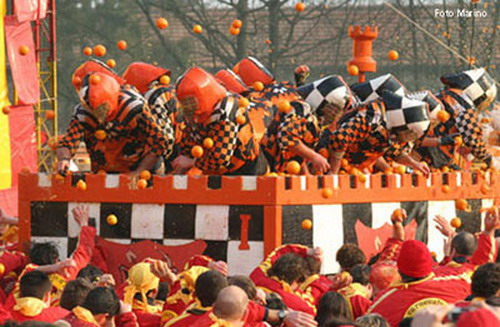
Ivrea Orange Festival
For some reason there are many food throwing festivals throughout the world.  One food throwing festival takes place in Ivrea, Italy each year.  The Ivrea Orange Festival started centuries ago when love-struck damsels in balconies threw oranges at suitors in parades. Soon the parade became an open-to-all orange slugfest which attracts tourists from all over the world.

Spain loves food trhowing festivals and is famous for them.  Probably the best know is Tomatina, which takes place in the Valencian town of Bunol.  In this festival participants get together and throw tomatoes at each other.  It is held on the last Wednesday of August, during the week of festivities of Buñol.  Many people wear goggles during this hour of chaotic fun, as the town becomes a red river of mayhem.

Another type of food festival is on June 29th and takes place in Haro, Spain.  This one though involves wine.  Bring a bottle of vino and prepare to be drenched in red wine in the heart of Spain's grape-growing region. After mass, crowds flock to the hills for the battle, where white shirts are stained bright purple by the end of the morning.

Hodaka Matsuri
Naked Festival
January in Japan is as cold as in other northern parts of the hemisphere. But the freezing temperature does not deter thousands of men running in the streets with nothing but a loincloth on them. Hadaka Matsuri is a festival for ritual purification held in different forms across Japan. In Inazawa, men in loin cloths struggle to touch a naked man called Shin-otoko for good luck. These naked festivals are fun events but with undertones of spiritual significance.

Color Throwing Festival
Hindo Color Throwing Festival
This is the only Hindu festival where people do not dress up for the occasion. In fact, the oldest of clothes are dug out from wardrobes in preparation for a huge color-throwing festival called Holi. In this spring festival associated with Lord Krishna, people play with colorful powders called gulal. Wet colors are also used in many parts of India. Food and drinks laced with a local cannabis plant called bhang are served during the festival feast.

Monkey Buffet
Monkey Buffet Festival
As the name suggests, this festival is a huge feast laid down for primates of Lopburi, Thailand.  Tons of fruits and vegetables are laid by devotees in honor of Hanuman, the monkey God. What follows next is absolute mayhem as hordes of monkeys swarm the site, start attacking the food piles and interacting with spectators. The festival over the years has become more lavish and has put this small province on the world tourism map.

Fish Swallowing Festival
Man swallowing live fish
in Belgium
This festival involves consuming fish, but in this case, the fish are still alive!  The last Sunday of every February, residents of Geraardsbergen, Belgium celebrate the Krakelingen festival, which commemorates an unsuccessful siege of the city.  They throw bread rolls at each other, and they gulp down small wriggling gray fishes called grondeling, which have been soaked in red wine.  The ceremony draws protests from animal rights activists who want to substitute the live fish with fish-shaped marzipan (which I am sure would taste much better).

Orange is the color for the Queen's Day Festivals
Queen's Day - The Netherlands
Although their queen's birthday is really during the winter, she celebrates it on April 30th, the country's official "Queen's Day" since 1949.  Orange is the national color, and the streets become a sea of fluorescent wigs, feather boas, and body paint, as crowds gather in the plazas and on boats in the canals.  Amsterdam is the center of the outdoor party, with many live music acts, but you will find similiar smaller festivals all over The Netherlands on this day.


These are just a few of the festivals that I found.  There are many more.  If you are traveling and stumble across a local festival, take time to check it out.  However, if they are throwing food, you might want to steer clear, unless you are wearing clothes you don't mind having ruined.  You really do learn alot about a culture and the people by attending a local festival.  So have any of you attended an unusual festival?  I would love to hear about it, if you have.

Thursday, March 7, 2013

Places Evoke Memories of Food

“It is always sad to leave a place to which one knows one will never return. Such are the melancholies du voyage: perhaps they are one of the most rewarding things about traveling.”
Gustave Flaubert

For me, experiencing new things when I travel is why I travel.  I especially love trying new foods that are specialties of that country.  I am not quite as adventuresome as Anthony Boudain.  If you watch the travel channel on television you know that he travels the world trying very unusual foods (bugs, brains, etc.)  I don't go that far, but if a country has a food that it is famous for, then I want to try it.

Dinner in China
You may say that you have tried foods from other countries from restaurants here at home.  Just because you have tried foods in the United States that is supposedly from a different region of the world, doesn't mean you have actually tried food from that country.  Restaurants here cater to American tastes, and the food is quite often different than what you will get when you are actually in that country.  As an example, I have eaten Chinese food here in the states thousands of times.  But when I went to China I found the food to be quite different from the food I had here in the states.  I enjoyed the food in China, and tried just about everything I was served, but it did not remind me of the food I had here.

Sometimes I will have a food and it immediately calls to mind a trip I have taken.  I remember having that food and it reminds me of the place where I ate it and the fun I had in that country.  Certain foods I will always associate with a place.  Moussaka is certainly one of those foods.  I had never had Moussaka until I went to Greece, now I have it often and even make my own.  None will ever taste as good as that very first taste though.  But whenever I have it, I think of sitting in the Plaka in Athens at a little sidewalk table, and I remember our waiter, who chatted with us and was quite funny.  And I fell in love with Moussaka.  I was already in love with Athens by then.
Greek Salad

Actually moussaka is not the only food I fell in love with in Greece.  The country has some of the best food I have ever eaten.  I really like the food of Greece.  I love lamb, and the Greeks use a lot of lamb in the dishes they prepare.  And Panzanella salad became a favorite, which is made with big chunks of bread.  The Greek salad is so different than the salads by that name here in the states.  The Greeks seldom use lettuce in anything, including their salads.  A true Greek salad is chunks of tomatoes, green peppers, sliced red onions, kalamata olives and fresh feta cheese, with a little olive oil and some herbs over the top.


Tapas in Spain
Tapas
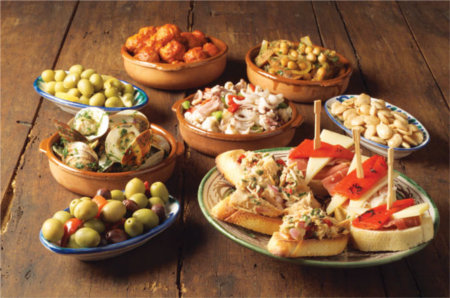
In Spain we went out each evening for tapas, which are small bites of food served either hot or cold, usually with a glass of wine or beer.  The tapas are served in the early evening to tide people over till dinner which is never eaten before 10:00 p.m.  Sometimes we ate so many tapas that we didn't need dinner.  But I did love the dinners there.  I really fell in love with gazpacho in Spain.  Gazpacho is a cold tomato soup.  It is delicious, and I ordered it almost every night while in Spain, as a starter to my meal.  Of coursethey are famous for their
paella and everyone who goes to Spain should try it, it is better than any paella you will get anywhere else.  And the Costa del Sol area where we were, had wonderful seafood dishes. 

Plaza Mayor in Madrid, getting ready for
the dinner crowd
One of the things I love about dining out in some of the European cities is that they dine outside all year long, in wonderful little town square areas.  They set up tables and all the neighbors come out with their kids and their dogs and they wander around the square, saying hello to each other.  The kids and the pets are playing, and people are having their dinner.  We have nothing like that here.


Tomato and Mozzarella Sandwich
We traveled to the Canary Islands in 2003.  We were on the island of Tenerife.  The food that I remember most from that trip was a tomato and mozzarella sandwich, on a long bagette type of bread.  It had basil leaves on it, and sometimes a thin sliced Spanish ham.  We were there with friends from Scotland, and almost everyday we would stop at a little outdoor restaurant somewhere and have one of those sandwiches with a beer, and watch the people, and enjoy the sunshine.  I have had other sandwiches similiar to them since that trip, but none seem quite as good as those were.  Maybe it was the company, or the sunshine, or the atmosphere, I'm not sure.  But I will always associate the Canary Islands with those sandwiches.


Squid in its own Ink
While in Croatia in 2010 I was told that the best seafood in the world was to be had there, and in particular that I should try the squid.  So one night my husband and I were at a typical outside restaurant, like the ones I described above, in a town square with children and pets, and families.  I decided to order the squid.  I have eaten squid here in the states, usually breaded, and had always enjoyed it.  When this arrived it really surprised me.  It was in a bowl, and it looked like a bowl of black rubber bands.  It was served in its own ink.  My first thought was, that it didn't look too appetizing.  My husband was looking a little askance at it.  But I will try almost anything, so I took a bite, and I was hooked.  It was delicious.  I practically licked the bowl.  It is a meal I will always remember, and it is one I loved.

In Thailand everything we ate was spicey.  We were eating some noodle dish and I bit into something that caused me to feel like I was breathing fire.  I turned bright red and started gulping my drink.  My husband laughed at me and thought I was over-reacting.  Then he bit into the same thing, and realized that it really was hot.  I do like Thai food, but I also learned to respect it for what it is, and to be careful. 

Me eating gelato in Italy
In Italy we fell in love with gelato.  Gelato is not just ice cream, it is smoother, richer and more flavorful.  It is in a class by itself.  We were in Italy during the summer, so it was hot out.  We stopped for a lemon gelato on our second day in Italy.  For the next 20 days, while we toured the country fell in love with Italy, we made a point of stopping everyday and enjoying a gelato.  Lemon is still my favorite flavor, I suppose because it was the very first taste I ever had of gelato, or maybe because it was just so refreshing on a hot day.  We tried almost every flavor available, but somehow kept going back to lemon.


Lemoncello
It is not only food that sometimes makes me think of a country.  Drinks also play a large part.  I found that the only thing I ever want to drink with either Chinese or Japanese food, is beer.  That is the drink they serve in those countries to drink.  Of course not everyone has beer, but it is the most common drink with the people of those countries.  It is what I had with every meal when I was in both of those places.

In Italy we spent a week in Sorrento, which is near Naples, Capri and Pompeii.  They are famous for their Lemoncello.  It is a lemon liquour.  It is sweet and sour at the same time.  It is an acquired taste, and I am not overly fond of it.  But when I think of Sorrento, I think of lemons, and Lemoncello.

In Spain we were served Schnapps after every meal.  We didn't order it, it was just set before us at the end of the meal.

Raki in Greece
 In Greece, it was Raki, which was put in front of us at the end of the meal.  Most of the time the Raki tasted like turpentine.  I did not enjoy it, so I would usually pass.  George drank them both, not that he enjoyed it, but he did it so I wouldn't have to.  But one night, on the island of Crete, we had a wonderful meal in the hills overlooking the town of Rethymnon.  They made their own Raki there, and it was smooth, and tasted wonderful.  I even bought a bottle to take home.  When Raki is made the right way, it is actually quite good.  Of course, Greece is more famous for its Oozo, and I also drank that while there.  I quite like Oozo, but then I also like licorice.

A Shandy
And last year we traveled with our Scottish friends across Scotland and around Ireland.  I discovered the Shandy.  A shandy is a mix of beer and "lemonade".  But the lemonade is not what we think of as lemonade, it is sparkling - more like a 7up with a slight lemon flavor.  You mix it with the beer and it is a light refreshing summer drink.  I was completely hooked on it throughout that trip.  Scotland will all be associated in my mind to the Shandy.


We are looking forward to traveling to new places soon.  Africa will be later this year, and I am sure I will have some new taste treats to look forward to there.  Some may be better than others, but I am looking foreward to trying whatever the locals prepare, it is part of the experience.  It is hard for me to imagine going to another country and instead of trying the food of the area, looking for familiar foods from home.  I know people do that, I have even traveled with some who will not try new things.  For me though, I would not feel I had really been there and experienced it, if I had not also tasted it.  So to all of you who are traveling to new places I say "Bon Apetite!"

Here is my recipe for Moussaka.  I hope you enjoy it.  It is as close as I can come to the Moussaka we had in Greece.

Moussaka
6 T. olive oil
1 onion, chopped
2 cloves garlic, chopped
1 pound ground lamb
1/2 Cup red wine
1 T. tomato paste
1 1/2 canned crushed tomatoes in puree
1 (1 pound) eggplant, peeled and cut into 1/4 inch slices
4 ounces cream cheese
1/4 Cup milk
1/2 Cup grated Parmessan
1 bay leaf
1 cinnamon stick
1/8 teas. ground allspice
1 teas. salt
fresh ground pepper

Heat the broiler.  In a large frying pan heat 1 T. oil.  Add onion and garlic.  Cook until softened.  Add the lamb and cook until meat loses its pink color (2 min.)  Stir in wine, tomato paste and tomates in puree, bay leaf, cinnamon, allspice, salt and pepper.  Bring to a boil.  Reduce heat and simmer covered 10 minutes.
Moussaka
Brush both sides of the eggplant slices with remaining oil and season with salt and pepper.  Put eggplant slices on a large baking sheet and broil, 6 inches from heat, until browned.  About 5 min.  Turn and broil until browned on the other side.

In a small saucepan, combine cream chees, milk 1/8 teas. salt and a pinch of pepper.  Warm over low heat until just melted.

Oil and 8 X 8 inch baking dish.  Layer half the eggplant in the dish, then half the meat sauce.  Sprinkle with half the Parmessan. Repeat with remaining eggplant, meat sauce and Parmessan.  Spoon the cream cheese sauce on top; broil until just starting to brown.  Serve hot.


Saturday, March 2, 2013

Destination - Madrid and Toledo

“Madrid is enjoyed most from the ground, exploring your way through its narrow streets that always lead to some intriguing park, market, tapas bar or street performer.   Each night we'd leave our hotel to begin a new adventure in Madrid and nine out of 10 times, we'd walk
through the Plaza Mayor.”
Emilio Estevez


Madrid
Madrid is the vibrant capital of Spain.  If you are going to Spain, it is quite often the city you will fly into to start your vacation.  It is worth spending a few days here.  Madrid is different from so many of Europe’s historic cities.  It is considerably smaller and younger.  It is a city without a lot of historic sights to see.  It is a friendly city, with culture and night life and wonderful food.  It is the heart of Spain.
Plaza Mayor
My husband and I visited Spain in September 2001.  We started and ended our visit in Madrid, and enjoyed exploring the city during the 3 days we spent there.  My favorite place in the city is Plaza Mayor (Main Square).  Plaza Mayor is an historical and stunning square. The square is very large, with shops all around.  I particularly remember all the shops displaying ham.  Ham or Jamon in Spanish, is a major food of the Spanish and you will find shops to purchase Jamon all over Spain.  In the evening the Plaza Mayor comes alive with families who come out to visit their neighbors, children playing, dogs being walked, or just playing with each other, and restaurants bring out chairs and tables and serve their food along the sides of the square.  It is a fun place to people watch.


tapas
In Spain, you do not eat dinner until around 10 p.m.  If you are hungry earlier you grab a table at a tapas bar, or under the stars at Plaza Mayor, and you order tapas.  Tapas are small bites of food, both cold and hot.  You might decide on some marinated cheese and some olives, or Tortilla de patatas (Spanish omelette) or tortilla española - a type of omelet containing fried chunks of potatoes and sometimes onion.  Tapas bars quite often have several seafood dishes to choose from, and tapas are quite often heavy with garlic and olive oil.  Usually you will have a glass of beer or wine with the tapa.  I loved going out for tapas, and sometimes filled up on them, and skipped dinner.

Madrid is a city for walking. The areas that you will want to see are all within walking distance.  There is public transportation if you want to go across town, but for the average tourist you will find most things within a short walk from your hotel.  Do be careful of pickpockets though, the city is full of them, so keep things in front pockets and purses in front of you.

Plaza de Espana

The main street in the city is the Gran Via.  The lively street is one of the city's most important shopping areas. It also contains a large number of hotels and large movie theaters. But what makes this street so special is the architectural design of many of the large buildings. While walking through this crowded street, make sure you look up once in a while and admire the often lavishly decorated buildings. 

At the western end of the Gran Via is the Plaza de Espana.  It is a large square and a popular tourist destination.  It features a monument to Cervantes, and is bordered by two of Madrid's most prominent skyscrapers. The Cervantes monument was built between 1925 and 1930. It was finished between 1956 and 1957.  The tower portion of the monument includes a stone sculpture of Cervantes, which overlooks bronze sculptures of Don Quixote and Sancho Panza. Next to the tower, there are two stone representations of Don Quixote's "true love", one as the simple peasant woman Aldonza Lorenzo, and one as the beautiful, imaginary Dulcinea.

Prado Museum
If you have an afternoon and are into art, then Madrid has one of the best art museums in the world.  The Museo del Prado features one of the world’s finest collections of European art, from the 12th century to the early 19th century, based on the former Spanish Royal Collection, and unquestionably the best single collection of Spanish art. Founded as a museum of paintings and sculpture, it also contains important collections of other types of works. A new, recently opened wing enlarged the display area by about 400 paintings, and it is currently used mainly for temporary expositions. El Prado is one of the most visited sites in the world.


The Plaza de Oriente is a charming square with the Royal Palace to the west side and the opera house to the east. There you will find statues of kings, manicured garden and stone benches.


Retiro Park in Madrid
Madrid's main park, El Parque de Retiro, is not far from the city's main tourist attractions such as the Prado Museum, and is a popular and magnificent place for a stroll. Home to several sculptures, monuments, and a boating lake, it also presents an annual book fair, and there are free concerts throughout the summer. Many local families spend their Sunday afternoons here, renting a horse-drawn carriage or paddling a rowboat in the pond. But it wasn't always this democratic, as in the 17th century only the royal family was allowed to use it privately, hosting pageants, bullfights, and mock naval battles. Only a century later did it open to the public, but even then visitors had to be formally dressed to enter.


Botin Restaurante
Oldest Restaurant in the World
If you are looking for a good place to have dinner, Madrid has the oldest restaurant in the world. Anywhere billed as the world’s oldest restaurant is going to have the tourists beating a path to its crumbly portals, but El Sobrino de BotĂ­n is as famous for its roasts as for its longevity (300 years old and counting). That old Spanish favourite, cochinillo – suckling pig – is it’s most famous dish.  We had that when we visited the restaurant, and it was quite good.  I enjoyed our meal and the atmosphere of the place.


And if you are looking for a place to go out in the evening and enjoy some Flamenco dancing, which Spain is famous for, then consider the Taberna Flamenca El Cortijo.  This famous tavern is famous for its Flamenco dancing and you can have dinner there as well. If you are in the mood for colourful dresses, foot tapping rhythm and raw passion expressed through dance, this small venue offers a lively atmosphere, giving the experience an authentic feel.

Alcazar in Toledo, Spain
Less than an hour from Madrid is the city of Toldeo.  You should definitely plan to spend a few days visiting this city as well, before you move onto the rest of Spain.  Where Madrid is younger and more modern, Toledo is an old walled city, with many sights to see.  You can get to Toledo from Madrid by train in less than 30 minutes and less than 10 euros.  You can do just a day trip, and be back in Madrid that evening, but if you can, spend a night or two, it is a fun city to explore.

We actually visited Toledo at the end of our trip.  We rented a car from Madrid and drove south and spent 2 weeks exploring Southern Spain.  We then drove back north, spending a few nights in Toledo before heading for the airport in Madrid and our trip home.  I think Toledo was one of the highlights of our trip, and I was glad I had allotted a few days just for that city.
Toledo is also a city to see by foot.  If you have a car you might as well just park it at the hotel, because trying to find another parking spot will be difficult.  And there is a lot to explore while on foot.  But, unlike Madrid which is fairly flat, Toledo is built on hills, so there will be a lot of up and down the hills while walking.
 
At the highest point in the city, looms the foreboding Alcázar.  The Alcazar is a stone fortification which was once used as a Roman palace in the 3rd century, it is now the site of the Army offices and a Army museum.  You will see it towering over the city.
 
Photo: Calle del Comercio in Toledo, Spain
Walking around in Toledo
Plaza de Zocodover is a lively square flanked by cafes that are prime places for people-watching.
It was here that for centuries the people of Toledo enjoyed their bullfights or, morbidly, gathered to witness public burnings at the stake carried out by the Inquisition.  Today it is just a place for people to gather.

The magnificent synagogue, Sinagoga del Transito, was built in 1355 by special permission of Pedro I (construction of synagogues was prohibited in Christian Spain). Toledo's former juderĂ­a (Jewish quarter) was once home to 11 synagogues. The bulk of Toledo's Jews were tragically expelled in 1492. From 1492 until 1877, it was variously used as a priory, hermitage and military barracks. The synagogue now houses the Museo Sefardi, open the same hours as the synagogue. The vast main prayer hall has been expertly restored and the MudĂ©jar decoration and intricately carved wooden ceiling are striking.

But the main thing to enjoy about Toledo is just walking around the city and exploring all the nooks and crannies.  It is an old historic walled city, with wonderful little shops and lots of great restaurants, tapa bars and places to sit outside and people-watch.
River and bridge near entrance to Toledo
**pictures taken from the internet
There is currently a problem with blogspot and importing pictures, so I cannot use my own pictures until the problem is fixed.

Friday, December 23, 2011

Where were you on 9/11?

“A journey is best measured in friends, rather than miles.”
 Tim Cahill

Seville
We were in Spain on 9/11. We left the states on September 1st and flew to Madrid. We spent several days exploring Madrid before we hopped in our rental car and took off for the Costa del Sol region. Our first stop was Cordoba, then on to Seville, Cadiz, Jerez to visit the Sherry bodegas and purchase some Sherry, then a couple of nights in Gibraltar at a wonderful hotel right on the water. We watched the big ships go by and we could just make out the continent of Africa across the strait. Then we stopped at Ronda for the day and ended up in Mijas where we had booked a condo through our timeshare . We had a week there to explore the area.

Our timeshare was Club La Costa, and we had a duplex with a view of the ocean in the distance. The other half of the duplex had a Scottish couple. We met them when we moved in. They were sitting on their porch and we said hello and chatted for a few minutes. We spent the next few days running around to different towns along the Costa del Sol area. On September 11th we spent the early part of the day in the town of Nerja, then visited some spectacular caves, drove to Malaga and took a swim, then ended up having dinner (around 10PM – as is the custom in Spain) at a little seaside outdoor restaurant. I had the paella. We didn't turn on the radio all day, and even if we had, it was all in Spanish. We got back to our condo at around midnight.
 
Mijas, Spain
The next day George suggested we do a leisurely day at the pool, just relax, swim, read and have lunch at the restaurant at the pool. There were very few people at the pool, and we had a very relaxing day. We headed back to the condo around 3PM. The Scottish couple, Myra and Malcolm were on their porch, so I went over to say hello. Myra said “I'm sorry about what's happening in your country!” I said “what's happening?” She was surprised that I didn't know. She took us into their place and turned on CNN. We stood there horrified by the news. Then Myra surprised me even more. She said “we knew you were from somewhere in the states, and you should know that all flights to the states have been canceled. You may not be able to get home. We'd like to invite you to come stay with us in Scotland, for as long as you need.” They didn't even know us, and they'd invited us to come stay indefinitely. I was amazed.

We didn't take them up on their offer. We knew we could get home before too long, and we decided it made more sense to stay in Spain, which is where our airline ticket was for. But after their generous offer we invited them to join us for dinner that night. We drove up to the hill town above us and had dinner in a cute little restaurant there. We found out we had a lot in common with them. We were the same age. And we had such a good time with them that evening. We did a lot of laughing, which we needed after the news of what was happening.

Toledo
Two days later we said good-bye to Myra and Malcolm. We exchanged email addresses and we promised to let them know when we did got home. We headed north to Toledo where we spent a couple of days. While there I called US Airways and asked them what they would suggest for our return. When I told them the date we were scheduled to leave, I was told that would be the first day they would be flying back to the states, and that we would need to be there 4 hours in advance. I was surprised that we would be on our scheduled flight, as others had been delayed for close to a week. She said that those scheduled had to go, the others would be worked in and special flights would be brought in to help. So we actually flew home on the day we were suppose to. I have to say that security and the amount of people trying to get home, made it a nightmare. And when we landed in Philadelphia the whole plane was silent, until we were on the ground, and then their was applause, everyone was glad to be back on home ground. Getting through security and clearing customs in Philadelphia was also a nightmare, but we got through and caught our flight home.

We emailed our Scottish friends and told them we'd arrived. They emailed back, and a long distance friendship was formed. In January 2003 Myra phoned us and asked if we would join them in the Canary Islands in September. I said yes, without hesitation. We spent a wonderful time with them there, and promised at the end of that trip, that we would meet them somewhere in the world every other year.

Myra & Malcolm with us in Boston
We have pretty much kept that promise. In 2005 they flew to Boston and we did our own fall tour of New England. In 2007 we met them in Greece, on the island of Crete. They had scheduled a trip to see us in San Diego in 2009, but Malcolm had to have open heart surgery, so instead they came here in 2010. We showed them San Diego and then drove them up through California to visit Yosemite and Sequoia, then all the way up to our cabin in Washington state. We came back down the coast with a stop in San Francisco. In June of 2012 we will fly to Scotland to visit them. Together we are taking a road trip over to Ireland.

September 11th and the events that happened that day were horrific. But for us a wonderful friendship came out of it. I doubt we would have made that connection if things had been normal. We treasure that friendship, and realize that we need to stop and connect with people whenever we can. We also need to occasionally stop and make sure we know what is going on in the world when we travel.

So where were you on 9/11?